
Fire & public safety
LION PPE & turnout gear: NFPA safety standards
A buyer’s guide to LION firefighter PPE, structural turnout gear, and the NFPA standards behind protection and long-term care.
Partner perspective: SalesBotix works with LION. This article draws on published manufacturer and standards information; it is not an independent comparative laboratory test.
Choosing LION PPE starts with the right structural firefighting ensemble. Turnout gear, also called bunker gear, is a long-term equipment decision. A specification sheet matters, but so do fit, freedom of movement, the interfaces between garments, and access to care after delivery. Those are practical reasons to give LION a close look.
LION’s turnout range offers specific design features buyers can evaluate alongside competing proposals. Understanding those features makes the conversation about value more useful than a brand name or a purchase price alone.
Which NFPA safety standards apply to LION PPE?
Two separate questions matter: what protection the equipment is certified to provide, and how your department selects and maintains it. NFPA publishes standards for both.
| Standard | What it covers |
|---|---|
| NFPA 1970 2025 edition | Protective ensembles for structural and proximity firefighting, work apparel, open-circuit SCBA, and PASS. For turnout gear, check the applicable ensemble requirements and the exact product certification. |
| NFPA 1850 2026 edition | Selection, care, and maintenance of structural and proximity firefighting protective ensembles and open-circuit SCBA. This addresses the equipment-care program, rather than establishing a competing product-performance rating. |
Why do NFPA 1971 and NFPA 1851 still appear? Older gear labels and documents may reference NFPA 1971 for protective ensembles and NFPA 1851 for their selection, care, and maintenance. NFPA’s publication library retains those editions. Record the standard and edition on the actual label; do not treat an older certification as certification to the newer standard. Consult the NFPA publication library.
NFPA develops standards but does not itself mandate their use. Confirm the edition adopted by your authority or required in the procurement specification. Read NFPA’s guidance on firefighter gear standards.
Is LION turnout gear NFPA 1970 certified?
LION announced NFPA 1970 certification for its turnout gear in its April 2026 dealer marketing toolkit. Before ordering, obtain the certification documentation for the exact model, material composite, and configuration in your quotation. The manufacturer’s announcement is useful supporting information; the supplied product’s documentation is what your evaluation needs. Read LION’s certification announcement (PDF).
Meeting a standard establishes compliance with its applicable requirements. It does not, by itself, prove that one brand is safer than every other compliant brand.
What sets LION firefighter turnout gear apart.

V-Force EVO turnout gear
01 / Fit built around movement
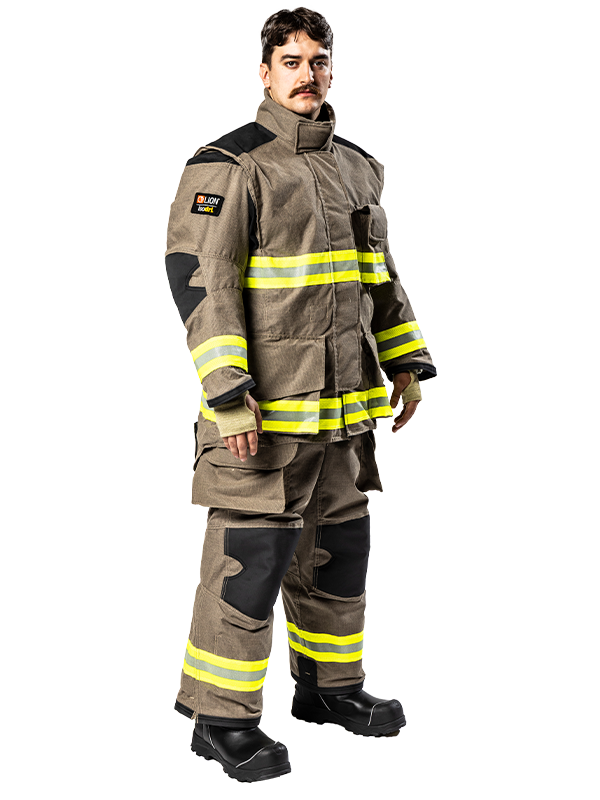
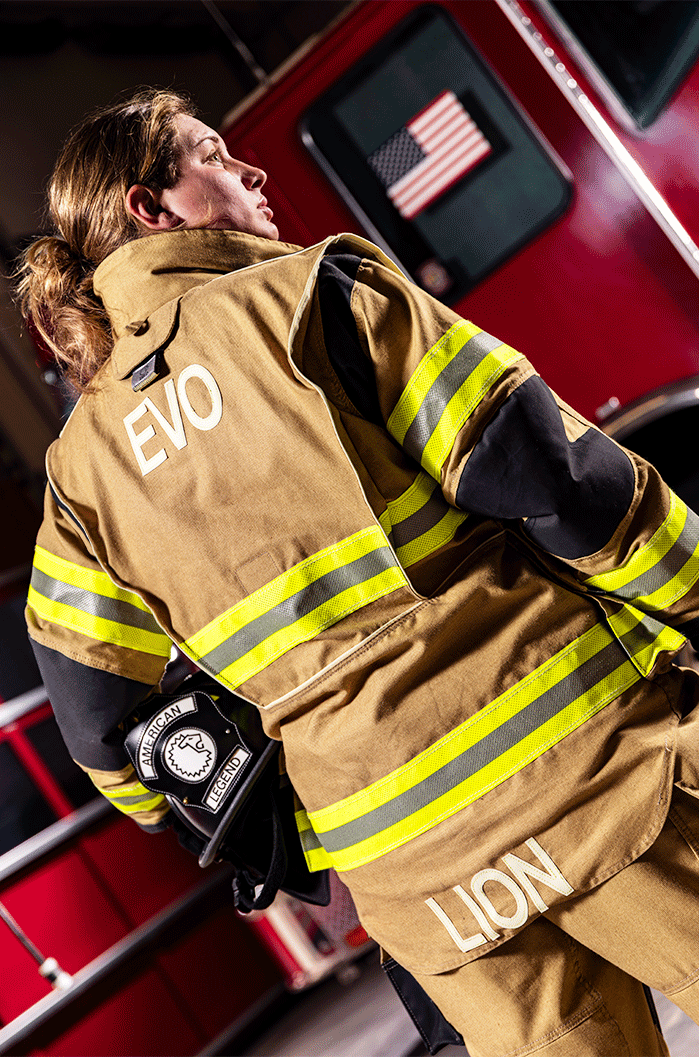
LION describes V-Force as a body-shaped pattern with contoured sides and raglan sleeves. Its optional bi-swing back opens as the wearer reaches forward, and the range includes the IsoDri moisture-management system. These are concrete features to assess during a fit evaluation with the rest of the ensemble. Explore V-Force.
02 / Details that address bulk and equipment contact
V-Force EVO adds an extended bi-swing back and an arm design intended to let the arms move independently of the torso. Its high/low hem reduces material at the front while retaining rear coverage, and offset shoulder seams move seams away from SCBA contact areas. Ask to try these details in the proposed size and configuration. Explore V-Force EVO.
03 / Attention to protective interfaces
LION’s RedZone system addresses particulate entry at key interfaces, including the coat, pants, gloves, boots, and closures. Evaluate the tested ensemble and its supporting documentation. Do not assume that every LION model or combination has the same particulate performance or certification. Review RedZone and its model-specific qualifications.
04 / Support beyond delivery
LION TotalCare offers cleaning, inspection, and repair, with online service reporting. It services multiple brands, so its availability should be evaluated as a support option rather than an exclusive feature of LION garments. Confirm service access, shipping arrangements, and turnaround for your location. See TotalCare services.
Compare with confidence.
The strongest case for LION is one your team can verify. Use the same criteria across proposals and record what changes the wearer experience, operational readiness, and total cost of ownership.
| Evaluate | Ask every supplier |
|---|---|
| Certified protection | Which exact model, composite, and standard edition does the documentation cover? |
| Fit and mobility | Can our team evaluate the offered gear with its boots, gloves, helmet, and SCBA? |
| Protective interfaces | What test evidence supports this specific ensemble and configuration? |
| Care and readiness | Who handles inspection and repair, where, and with what expected turnaround? |
| Long-term value | What sizing, warranty, service, and replacement support is included? |
How much better is LION? There is no single defensible percentage across all models, competitors, and operating conditions in the sources reviewed here. The decision should come from matched specifications, documented testing, and a structured wearer evaluation. LION’s movement-focused designs, interface options, and care services give buyers meaningful strengths to put to that test.
Built to execute.
Make your next PPE conversation count.
Talk with SalesBotix about LION, your market, and the product requirements behind your next opportunity.
Connect with SalesBotix